
Alzheimer’s Disease is a progressive neurodegenerative disorder and the most common cause of dementia, meaning it affects thinking, memory, and daily functioning. It is characterized by gradual loss of brain cells, particularly in regions involved in memory and language. The exact cause is not fully understood, but it is associated with abnormal deposits of proteins in the brain, including beta-amyloid plaques and tau tangles. Risk increases with age, and having a family history can raise likelihood, especially in some early-onset forms. Other contributing factors that have been studied include vascular disease, metabolic and lifestyle factors, and overall brain health, though these do not fully explain all cases.
Commonly, symptoms begin with memory impairment, especially difficulty learning new information, and then expand to other cognitive domains. People may experience confusion, trouble with planning or problem-solving, language difficulties, and disorientation to time or place. As the condition advances, changes in behavior and mood can occur, including agitation, apathy, or personality changes. In later stages, individuals may lose the ability to carry out basic activities of daily living and may develop complications related to advanced cognitive decline. The pattern and speed of progression can vary between individuals, but the overall course is typically worsening over time.
Alzheimer’s disease was first described in 1906 by German psychiatrist and neuropathologist Alois Alzheimer, based on observations of a patient with progressive cognitive decline. Over subsequent decades, researchers clarified the clinical features of dementia and linked them to characteristic brain pathology, including amyloid plaques and neurofibrillary tangles composed of tau protein. The terminology “Alzheimer’s disease” and “Alzheimer disease” are both used in medical literature, reflecting common naming conventions. Epidemiologically, it is a major public health concern because the number of affected individuals rises substantially with population aging. Today, Alzheimer’s disease is widely studied as a leading cause of disability and dependence in older adults, with ongoing research focused on understanding its underlying mechanisms and variability.
Note: This description was generated by AI and may contain inaccurate information.
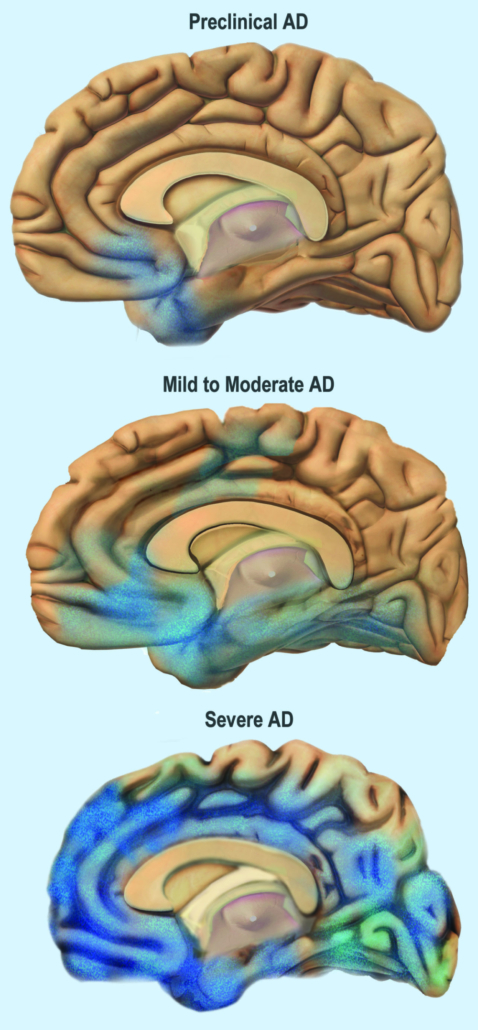
Original Image Producer: NIH Image Gallery from Bethesda, Maryland, USA. Credit: Alzheimer’s Disease, Spreads through the Brain. License: Public domain. Link to Source: https://commons.wikimedia.org/wiki/File:Alzheimer’s_Disease,_Spreads_through_the_Brain_(24524716351).jpg .