Bladder Cancer refers to malignant tumors arising from the epithelial lining of the urinary bladder, most often the urothelium (also called transitional epithelium). It is sometimes described as urothelial carcinoma and, historically, as transitional cell carcinoma. Less commonly, other cancers can involve the bladder, but the term “bladder cancer” in routine clinical use usually focuses on urothelial malignancies rather than non-epithelial tumors such as lymphoma or sarcoma. Bladder cancer develops when genetic and epigenetic alterations allow abnormal cells to proliferate, invade surrounding tissue, and potentially metastasize. Contributing factors include tobacco smoking, occupational exposure to aromatic amines and certain industrial chemicals, chronic bladder irritation, prior pelvic radiation, and long-standing urinary tract inflammation.
Bladder cancer commonly presents with hematuria, meaning blood in the urine, which may be visible (gross) or detected only on urinalysis (microscopic). Other symptoms can include urinary frequency, urgency, dysuria (pain or burning with urination), and suprapubic discomfort, reflecting irritation of the bladder lining. The disease may remain limited to the inner lining for some patients, while others develop invasion into the bladder muscle, which is associated with a higher risk of spread. Symptom patterns can vary with tumor size, location within the bladder, and whether carcinoma in situ (a flat, high-grade lesion) is present. Progression is often described in terms of tumor stage and grade, with higher-grade tumors tending to behave more aggressively even when initially small.
Historically, bladder tumors were classified by their microscopic appearance, and the term transitional cell carcinoma became widely used because many tumors resembled normal transitional epithelium. Over time, advances in pathology and molecular understanding led to broader terminology, with urothelial carcinoma becoming the preferred umbrella term for most bladder epithelial cancers. Epidemiologically, bladder cancer is more common in older adults and is strongly associated with smoking in many populations. Incidence patterns have varied by region and over time, influenced by changes in tobacco use and occupational regulations. Modern classification also reflects the clinical importance of distinguishing non–muscle-invasive disease from muscle-invasive disease.
Urothelial tumors are commonly categorized by stage (how deeply the tumor has invaded) and grade (how abnormal the cancer cells appear under a microscope). Non–muscle-invasive disease includes tumors confined to the urothelium or subepithelial connective tissue, whereas muscle-invasive disease involves the detrusor muscle of the bladder wall. Variants and subtypes exist, including papillary and flat (carcinoma in situ) growth patterns, and some tumors show divergent differentiation. Pathologic evaluation typically assesses invasion depth, presence of carcinoma in situ, and features linked to recurrence risk. Identification and staging rely on histologic confirmation and imaging-based assessment of local extent and potential spread.
Note: This description was generated by AI and may contain inaccurate information.
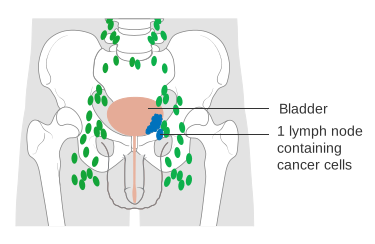
Original Image Producer: Cancer Research UK uploader. Credit: Own work. License: CC BY-SA 4.0. Link to Source: https://commons.wikimedia.org/wiki/File:Diagram_showing_stage_N1_bladder_cancer_CRUK_444.svg .