
Bladder Cancer refers to malignant tumors arising from the epithelial lining of the urinary bladder, most often the urothelium (also called transitional epithelium). It is sometimes described as urothelial carcinoma and, historically, as transitional cell carcinoma. Less commonly, other cancers can involve the bladder, but the term “bladder cancer” in routine clinical use usually focuses on urothelial malignancies rather than non-epithelial tumors such as lymphoma or sarcoma. Bladder cancer develops when genetic and epigenetic alterations allow abnormal cells to proliferate, invade surrounding tissue, and potentially metastasize. Contributing factors include tobacco smoking, occupational exposure to aromatic amines and certain industrial chemicals, chronic bladder irritation, prior pelvic radiation, and long-standing urinary tract inflammation.
Bladder cancer commonly presents with hematuria, meaning blood in the urine, which may be visible (gross) or detected only on urinalysis (microscopic). Other symptoms can include urinary frequency, urgency, dysuria (pain or burning with urination), and suprapubic discomfort, reflecting irritation of the bladder lining. The disease may remain limited to the inner lining for some patients, while others develop invasion into the bladder muscle, which is associated with a higher risk of spread. Symptom patterns can vary with tumor size, location within the bladder, and whether carcinoma in situ (a flat, high-grade lesion) is present. Progression is often described in terms of tumor stage and grade, with higher-grade tumors tending to behave more aggressively even when initially small.
Historically, bladder tumors were classified by their microscopic appearance, and the term transitional cell carcinoma became widely used because many tumors resembled normal transitional epithelium. Over time, advances in pathology and molecular understanding led to broader terminology, with urothelial carcinoma becoming the preferred umbrella term for most bladder epithelial cancers. Epidemiologically, bladder cancer is more common in older adults and is strongly associated with smoking in many populations. Incidence patterns have varied by region and over time, influenced by changes in tobacco use and occupational regulations. Modern classification also reflects the clinical importance of distinguishing non–muscle-invasive disease from muscle-invasive disease.
Urothelial tumors are commonly categorized by stage (how deeply the tumor has invaded) and grade (how abnormal the cancer cells appear under a microscope). Non–muscle-invasive disease includes tumors confined to the urothelium or subepithelial connective tissue, whereas muscle-invasive disease involves the detrusor muscle of the bladder wall. Variants and subtypes exist, including papillary and flat (carcinoma in situ) growth patterns, and some tumors show divergent differentiation. Pathologic evaluation typically assesses invasion depth, presence of carcinoma in situ, and features linked to recurrence risk. Identification and staging rely on histologic confirmation and imaging-based assessment of local extent and potential spread.
Note: This description was generated by AI and may contain inaccurate information.
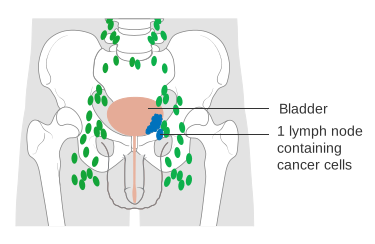
Original Image Producer: Cancer Research UK uploader. Credit: Own work. License: CC BY-SA 4.0. Link to Source: https://commons.wikimedia.org/wiki/File:Diagram_showing_stage_N1_bladder_cancer_CRUK_444.svg .
Bladder tumor reduced after alternative treatments and dietary changes
1/31/12 – tumor in the bladder, Part 1
The BS 1.31.12
To all who have a fear of cancer
Here I would like to describe my case.
In December 2010 I was first told I had some blood in the urine. I have to say I do not belong to the people who run constantly for doctor. This study has been undertaken to extend my PB bill to let. Before that I was already at least 30 years not been to a doctor. I have taken note of but continue to be ignored.
From November 2011 my urine was so bloody Allerding now but I once visited a urologist. The subsequent cystoscopy had revealed a tumor that I had about 3 cm from the bladder. It has given me to understand with sharp words, which I should now take all the school medical measures to ensure my survival. This I categorically refused and told him that there is more than conventional medicine in order such a thing to go and I did not want periods as will-less zombie conventional medicine my life. He became very angry and I just walked away. I made another appointment with another urologist in the hope that was a little more accessible. How can you imagine perhaps that was also quite annoyed by my suggestion try it with alternative methods. The last words we read have changed as follows: Doctor, when they take on the medical school activities I do not promise you that you die in pain because (and this from a doctor). To which I replied that that will not happen for sure and this time just went off without any further agreements.
Then I started following my alternative program.
10-12 hours 6-10 drops MMS, colloidal silver water ½ -1 liter, pure DMSO on the bottom and genitals to the area where the bladder (somewhat painful) then pain away. I also have my complete food re-adjusted for the most part Budwig diet. No more meat and I mean no meat that involves all kinds of meat, no bread, no sugar and all the goodies are also deleted. Instead, all kinds of vegetables, cheeses of all kinds, only linseed oil and various fruit and vegetable juices, cottage cheese and cottage cheese as flaxseed include fresh shredded also included. With a little creativity can conjure up tasty dishes from it. Thus, complete conversion of sugar to protein combustion combustion.
Result of tumor after 3 ½ weeks, departed on the urethra, no more blood in the urine and the pain is gone too.
I have a bladder cancer can make test result is pending. Will continue to report.
My energy is almost no longer hold out.
So I hope I’m giving all human courage and try it this or something similar, not identical fall into a coma in the diagnosis of cancer.
Best regards and thanks to Jim Humble
B.F.
Grandfather's energy and mouth infection returned after MMS use
{Various different profiles}
I mentioned before that my grandfather, 59, has cancer that originated from the colon. He has tumors in his bladder. I advised for him to make his way to 15:75 but what you say makes sense since he has recently reported a lack of energy and a yeast infection in his mouth that was gone had come back.
{2/25/11}
…The last I heard, he was at 9:45 with MMS. Ever since my grandmother started giving him higher than a 4:20 dose, she has reported that he has good and bad days…
{3/25/09}
According to my wife my grandfather’s condition is improving and he is receiving physiotherapy on his legs.
{4/27/09 by Anonymous Coward 659131}
…MMS helped prolong my grandfather’s life. He died on Friday, but not from MMS…